Hungary's Hidden Immigration Surge: 252,000 Foreign Nationals and Counting
Co-written with Claude
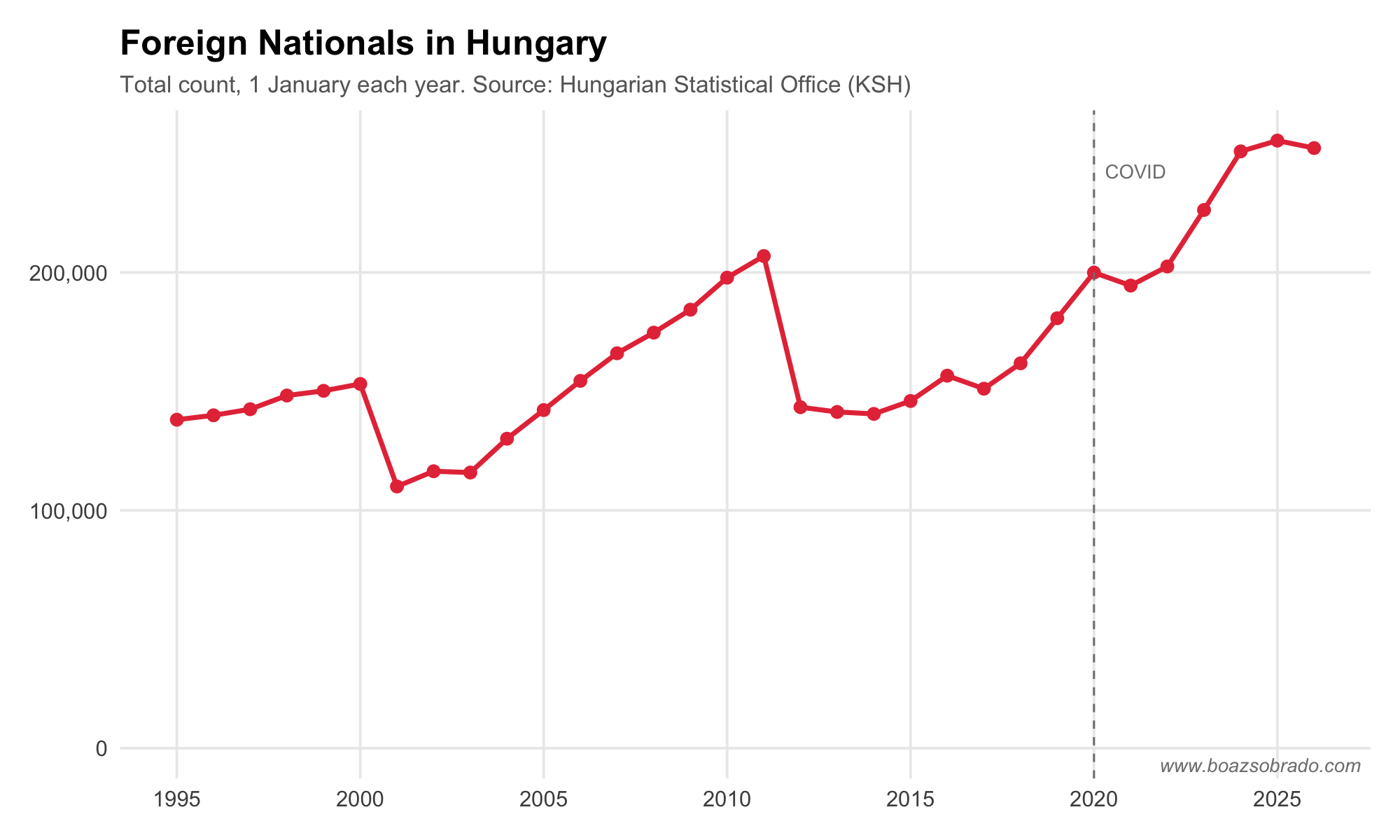
Last October I posted a thread on X about Hungary’s immigration surge. The data has since been updated with January 2026 numbers from the Hungarian Statistical Office (KSH). The picture has only become more striking.
Despite Viktor Orbán’s anti-immigration rhetoric, Hungary now has 252,000 foreign nationals. Nearly double the pre-COVID level.
Why Did Hungary Import So Many Workers?
Hungary had some of Europe’s worst post-COVID inflation. The government brought in foreign labour to fill shortages and cool wage pressures. Employment-purpose foreign nationals went from 39,000 in 2015 to 101,000 in 2025. That number has since dipped slightly to 95,000, but the structural shift is already locked in.

The Continental Shift
The composition of Hungary’s foreign population has been quietly transformed.
In 1995, 89% of foreigners in Hungary were European, with just 7% from Asia. By January 2026, that had shifted to 53% European and 39% Asian. This isn’t a blip. It’s a structural recomposition of who lives and works in Hungary.

The Romanian Collapse
Romanians used to be half of all foreigners in Hungary (50% in 1995). Today they’re just 6%.
Two forces drove this collapse. First, Hungary offered simplified citizenship to ethnic Hungarians abroad starting in 2010, converting many Romanian-passport holders into Hungarian citizens. Second, Romania’s economy grew substantially relative to Hungary’s, reducing the incentive to migrate.
Someone had to fill the gap.

Who Filled the Gap?
Of the approximately 52,000 new foreign nationals added between January 2020 and January 2026:
- Non-Chinese Asians: +34,800 (67% of all growth)
- China: +9,500
- Africa: +5,400
- Europe: +2,500
Europe barely moved. Asia, overwhelmingly non-Chinese, is the entire story.

The Invisible Majority
The largest group of foreigners in Hungary is now a category that KSH doesn’t even break down by individual nationality: “Non-Chinese Asians.” At 68,250 people, this group is larger than Chinese, German, Ukrainian, or Romanian nationals individually.
Who are they? Mostly South and Southeast Asian guest workers. You see them delivering food across Budapest.

The Guest Worker Signal
The male-to-female ratio confirms that these aren’t families settling down. The non-Chinese Asian M/F ratio has surged to 1.6×, the highest gender skew of any group in Hungary.
Compare that to Chinese nationals, who are approaching gender parity. These are very different migration patterns: Chinese migration to Hungary looks like settlement; the non-Chinese Asian influx looks like a temporary guest worker programme.

The Russia-Ukraine Irony
One more irony in the data. Ukrainian nationals in Hungary spiked to 36,000 after Russia’s invasion, but have since faded to 17,000 as many moved on to other EU countries or returned home. Meanwhile, Russian nationals have quietly doubled to 7,650 since the invasion began.

Conclusion
Post-COVID, economic reality trumped political rhetoric across Central Europe. Hungary was no exception. Whatever Orbán says on the campaign trail about defending Hungary’s borders from migrants, the data tells a different story: the government actively imported tens of thousands of Asian guest workers to keep the economy running.
The question now is whether this guest worker population becomes permanent, or whether Hungary follows the pattern of Gulf states, cycling through temporary labour without integration. The gender ratio data suggests the latter, but demographics have a way of surprising policymakers.
All data from the Hungarian Statistical Office (KSH), tables 22.1.1.23 and 22.1.1.25. Originally posted as a thread on X.