When Boomers Were Young, the Young Came First. Now They Are Old, the Old Do.
Poverty data from the US, the UK and nine other rich countries shows the risk of being poor moving from the old to the young as the baby boomers aged.
This post was co-written with Claude Code.
When the baby boomers were starting work, the poorest people in America were the old. In the late 1960s, 27% of Americans over 65 lived below the official poverty line, against 16% of children.
Today the boomers are retiring, and the order has flipped. Poverty among the over-65s has fallen to 10%. Among children it is 15%, and for most of the past forty years it was closer to 20%.
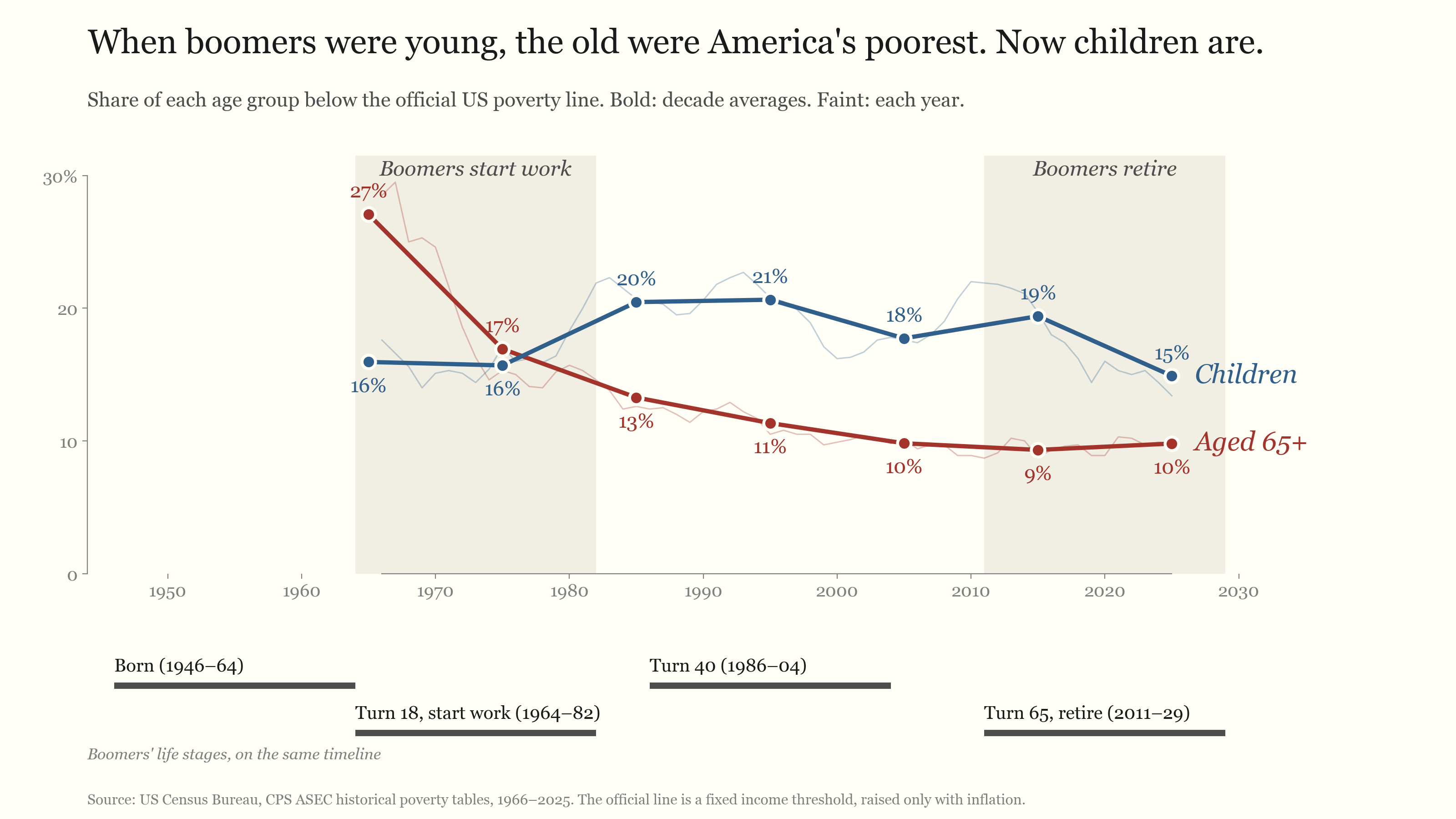
A generation that voted for its own stage of life
Old-age poverty did not fall by accident. It fell because governments chose to protect pensions, and kept protecting them.
In the US, Congress raised Social Security by 20% in 1972 and tied it to inflation from then on.The 1972 Social Security Amendments. Automatic cost-of-living increases began in 1975. Pensioners have been shielded from rising prices ever since. Poor families with children got no such guarantee. The 1996 welfare reform ended their right to cash aid altogether.The Personal Responsibility and Work Opportunity Reconciliation Act replaced Aid to Families with Dependent Children with time-limited block grants to the states.
Britain did the same in its own way. The triple lock, introduced in 2011, raises the state pension each year by whichever is highest: inflation, wage growth or 2.5%. Over the same years, child benefits were frozen from 2016 to 2020 and capped at two children from 2017.The two-child limit applies to Universal Credit and Child Tax Credit for children born after April 2017.
The pattern fits the life cycle of one large generation. When the boomers were young and starting families, the welfare state was built around working families. As they approached retirement, it was rebuilt around pensioners. Older people vote at much higher rates than younger people, and the boomers have been one of the largest voting blocs in most rich countries for decades. Politicians noticed.
It is not just America
The same reversal shows up across Europe and in Canada. In Britain, pensioner poverty fell from 38% in the 1960s to 16% today, while child poverty doubled, from 14% to 29%. Greece, Norway, Italy, Luxembourg and the Netherlands went the same way: in each, children are now more likely to be poor than older people.
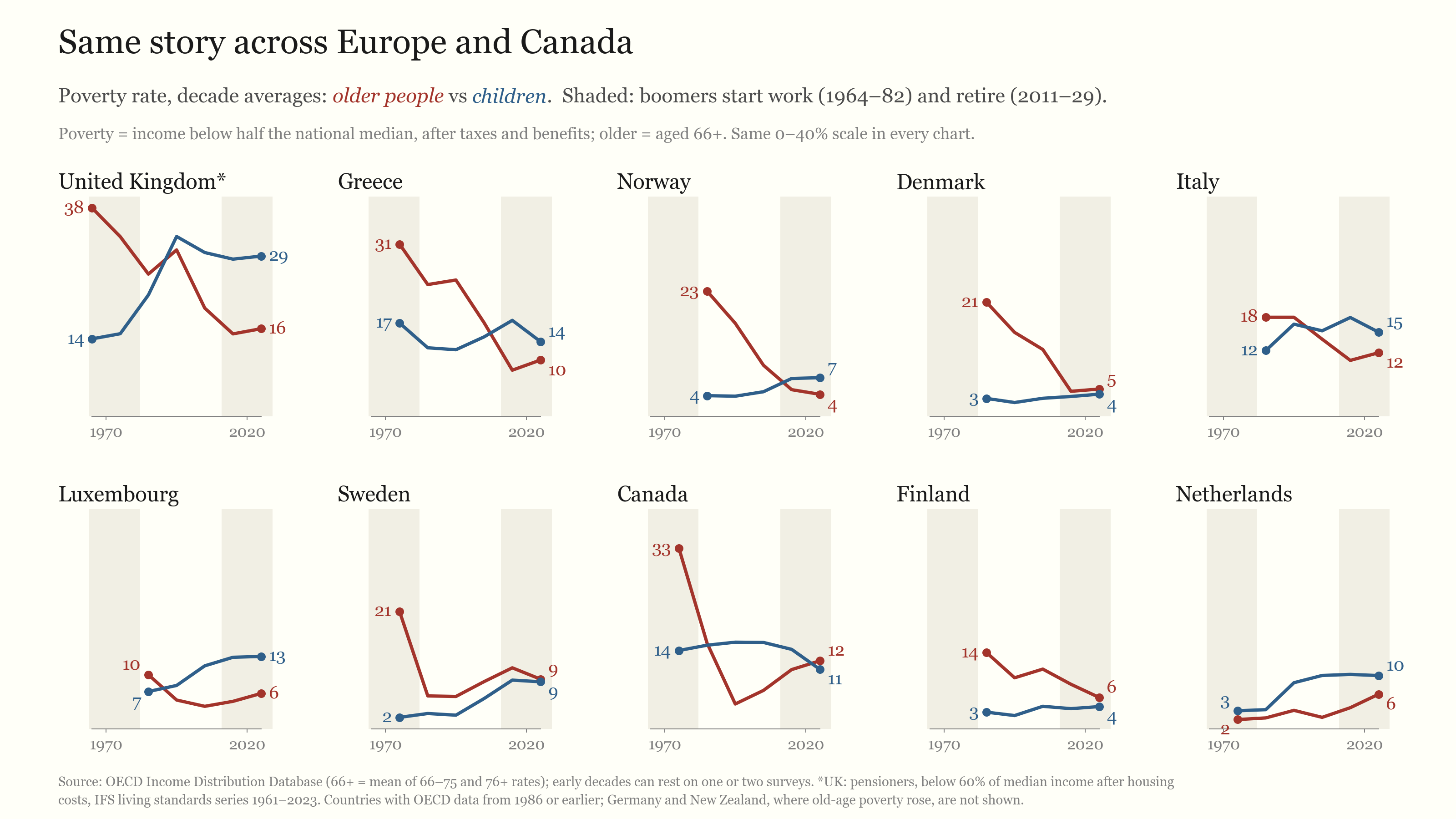
In Denmark, Sweden, Finland and Canada the gap closed rather than flipped, but the direction is the same. Older people went from being by far the poorest group to being no poorer than children.
What this does and does not show
These charts show outcomes and the policies that produced them. They do not prove motive. A generation can benefit from a system without having designed it for itself, and much of the fall in old-age poverty was a genuine achievement: in 1970, being old in America meant a one-in-four chance of being poor.
But the asymmetry is hard to miss. Pensions were indexed, protected and in Britain locked. Support for families was frozen, capped or cut. Each choice was made by governments elected by an electorate that grew older every year.
Notes on the data
The US figures are the Census Bureau’s official poverty rates, which measure household income against a fixed threshold set in the 1960s and raised only with inflation. The UK figures come from the Institute for Fiscal Studies and count people below 60% of median income after housing costs. The other countries use the OECD’s Income Distribution Database, which counts people below half their country’s median income after taxes and benefits, with older people defined as 66 and over.
Each line is an average for the decade. The levels are not comparable across countries, because the poverty lines differ; the direction within each country is the point. For several OECD countries the earliest decade rests on one or two surveys. I included every OECD country with data going back to 1986 or earlier, except Germany and New Zealand, where old-age poverty rose rather than fell.